This article was co-written with the assistance of Claude, a multimodal AI model developed by Anthropic.
If you’re joining this conversation for the first time
One year ago I published an article asking a straightforward question: what if the structural failures of representative democracy could actually be fixed, rather than patched, by designing a better system from first principles using technology that didn’t exist a generation ago?
The short answer was yes. This article goes much further.
The Open Governance Protocol (OGP) is a proposed governance infrastructure built on three foundations. Every citizen gets one verified, non-transferable digital identity, equal regardless of wealth. An AI-generated briefing informs every vote that any citizen or auditor can verify. And a public blockchain records every decision permanently where nothing can be quietly altered after the fact.
For readers who came from Part 1: I have now designed the full constitutional architecture, the economic framework, the court hierarchy, the expert governance model, and built a working technical proof of concept. All of the code is open-source and freely available.
For new readers: everything you need is in this article. You don’t need to have read Part 1, though I’d encourage you to after this.
Part 1 is available here: Corruption-Resistant Government: Revolutionising Democracy
OGP is not a political party, an ideology, or a manifesto. It is a protocol, infrastructure in the same sense that TCP/IP is infrastructure for the internet. Any jurisdiction can adopt it. No single entity owns it. It exists to make honest government structurally easier than corrupt government.
Why systems thinking, and why now
Most governance reform proposals target symptoms. Term limits address one specific abuse of power. Campaign finance rules address another. Lobbying restrictions address a third. Each intervention is correct in isolation and consistently insufficient in practice, because the underlying system routes around it. Money finds new channels. Power concentrates through new mechanisms. The symptoms keep appearing because the cause hasn’t changed.
Systems thinking asks a different question: what is the architecture that makes corruption the path of least resistance? And having identified it, how do you replace the architecture rather than patch it indefinitely?
People have been trying to patch it since the first human systems of governance emerged. Athens executed Socrates by democratic vote in 399 BC. The Roman Republic, designed with sophisticated checks and balances, collapsed into empire within five centuries. Medieval feudal systems entrenched hereditary power so thoroughly that it took violent revolutions to dislodge them. The modern democratic era, which we tend to think of as stable and relatively functional, has still produced the concentration of wealth and political power that we’re now living with. Centuries of attempted reform have not solved the underlying problem.
That doesn’t mean reform is hopeless. It means the problem is architectural. Patching produces better patches. Replacing the architecture produces a better system.
Three technologies changed the equation
Three technologies make that replacement possible today, when it wasn’t possible before:
- Cryptographic identity at scale: Zero-knowledge proofs can now confirm that one real human equals one vote, for hundreds of millions of people at once, without revealing who anyone is or how they voted. This solves the anonymity problem that made direct democracy impossible in Athens.
- AI-assisted deliberation: Open-source language models can produce accurate, plain-language, multilingual policy briefings with risk analysis and confidence ratings in minutes. This gives every citizen access to the kind of expert analysis that used to be available only to governments and well-funded lobby groups.
- Immutable public ledger: Blockchain infrastructure now records and executes decisions at costs below one cent per transaction, permanently, with no party able to alter the record after the fact. There is nothing to corrupt because nothing is hidden.
None of these existed at meaningful scale twenty years ago. All three exist at production scale today. The question is whether we use them.
The constitutional architecture
The most important lesson from millennia of democratic experimentation is this: democracy without an unamendable floor is not really democracy. It is a mechanism for whoever outnumbers whom today to do whatever they want to everyone else. Athens executed Socrates by popular vote. Nazi Germany dismantled democratic institutions using democratic tools. Both failures happened in systems with no constitutional protection strong enough to survive a sufficiently motivated majority.
OGP addresses this through a four-tier constitutional structure where each tier has a different level of protection:
Tier 1: Rights that no vote can ever touch
These cannot be altered by any vote, any supermajority, any declared emergency, or any future generation of citizens. They exist precisely to protect minorities from majorities, dissidents from governments, and the future from the present.
- Civil liberties: free speech, freedom of assembly, privacy, freedom of thought and conscience, freedom of the press.
- Existence rights: right to life, freedom from torture, equal protection, due process before any court.
- Social floor: right to healthcare, education, food security, shelter, and clean water.
- Democratic rights: right to vote, right to recall any official, right to receive a full briefing before any vote is cast.
The social floor is deliberate. Finland, Norway, Sweden, and Denmark consistently rank at the top of global happiness and wellbeing indices. They treat healthcare, education, and basic material security as constitutional rights, not discretionary policy. Societies that treat these things as floors rather than aspirations produce healthier, more innovative, and more trusting populations. The evidence has been building for decades.
Tier 2: Social contract rights (80% supermajority required to amend, plus a two-year deliberation window)
Economic rights, property rights, and environmental rights live here. They are protected but can change, because society’s understanding of fair economic arrangements legitimately evolves. Any amendment requires 80% of citizens to agree, plus constitutional court approval, plus a mandatory two-year period during which the AI advisory system models consequences and citizens can study them before the final vote.
Tier 3: Protocol rules (60% supermajority, six-month deliberation)
The rules that govern OGP itself: voting mechanisms, expert panel structure, AI oversight, the lobbying ban, the court structure, the diplomatic corps mandate, and the definition of natural monopolies. Adjustable, but not quickly.
Tier 4: Ordinary policy (simple majority)
Budget, service contracts, programmes, and regulations. Voted on each cycle, reversible, always subject to every tier above.
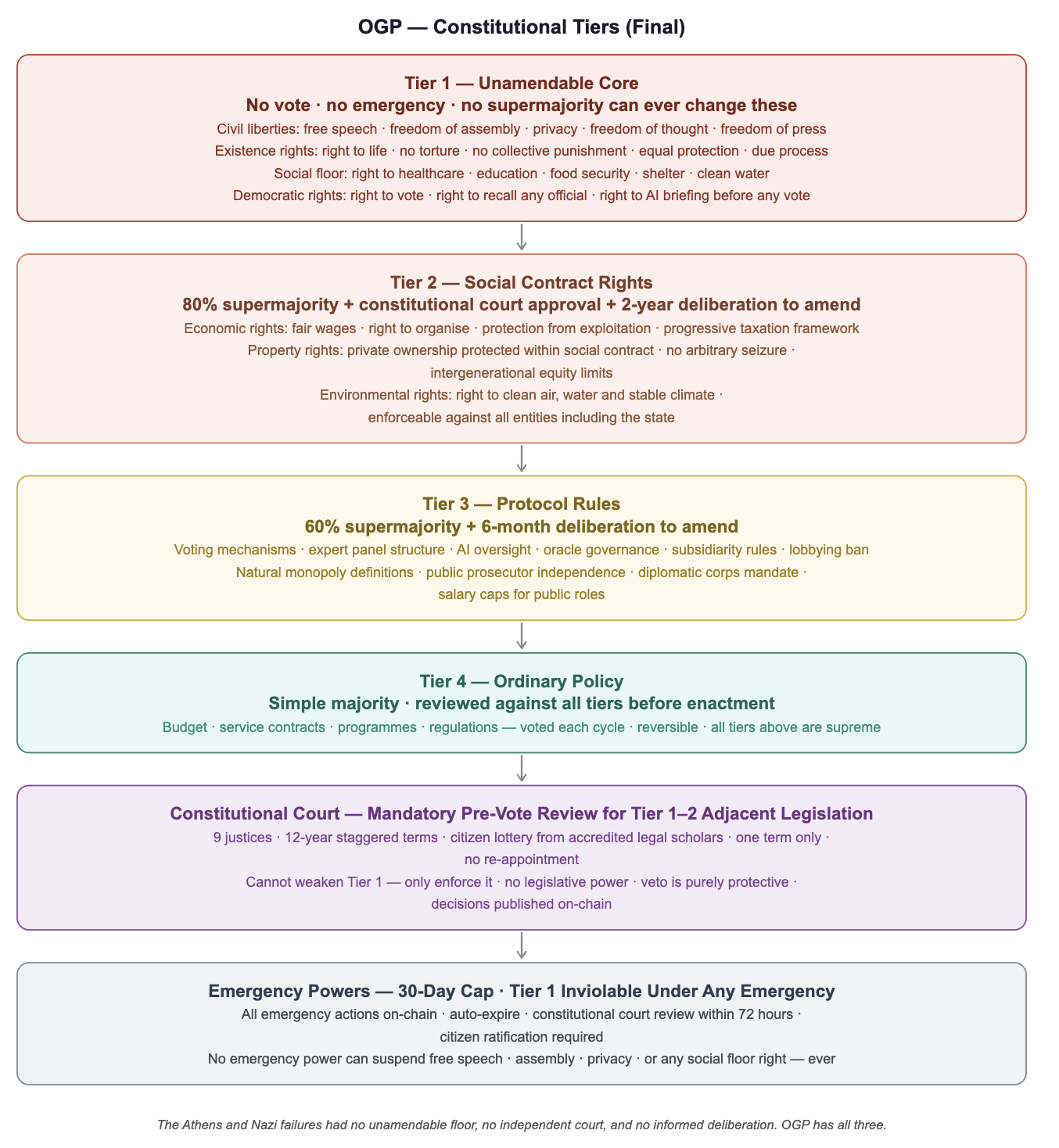
The deliberation windows are the architectural answer to impulsive collective decision-making. Fourteen days minimum for ordinary policy, two years for anything touching Tier 2. Time, combined with mandatory AI briefing, is the most reliable protection against the kind of sudden shift that brought Weimar Germany down. OGP builds both in as requirements, not recommendations.
The economic framework
One of the most common objections to governance reform is that it just trades one set of concentrated power for another. OGP takes that seriously. The Scandinavian model offers the most credible empirical answer available: societies with the most progressive economic structures consistently produce the best outcomes on happiness, health, life expectancy, social mobility, and institutional trust.
In practice, the Nordic countries do not use hard wealth caps. They use progressive taxation steep enough to achieve equivalent distributional outcomes through a proven, flexible mechanism that is substantially harder to work around than hard limits. Denmark’s top marginal income tax rate was around 56% in 2024, rising above 60% in 2026. Sweden’s is around 57%. Both countries consistently outperform on almost every social wellbeing measure compared to lower-tax alternatives with similar or higher GDP per capita.
Three components working together
OGP’s economic architecture has three components:
- Steep progressive income and profit taxation, with rates set by citizen vote and adjustable only by 80% supermajority. This is the Scandinavian model applied directly.
- An annual wealth levy on accumulated net assets above a citizen-voted threshold. Income taxes only capture new flows of money. The wealth levy addresses what’s already accumulated, which is where generational inequality actually lives.
- A Citizen Prosperity Fund, collectively owned by all citizens equally. This is modelled on Norway’s Government Pension Fund, now worth over two trillion US dollars and the largest sovereign wealth fund in the world. It was built from petroleum revenues and is owned by every Norwegian citizen equally, now worth roughly $340,000 per person in value. The fund pays a universal dividend, finances public services, and invests for future generations.
One exception to the progressive tax model: explicit salary caps apply to publicly-funded roles specifically, since the public is the direct payer. Expert panel members, judges, public prosecutors, and protocol administrators have one income source. The rate is generous but transparent, with no bonuses, equity grants, or outside earnings during service. A paid five-year cooling-off period after leaving public service makes the revolving door between government and private industry structurally impossible rather than merely discouraged.
Importantly, competition and enterprise are explicitly preserved. OGP is not anti-capitalist. What changes is that the surpluses generated in a stable, educated, healthy society are shared with the citizens whose collective investment made that stability, education, and health possible in the first place.
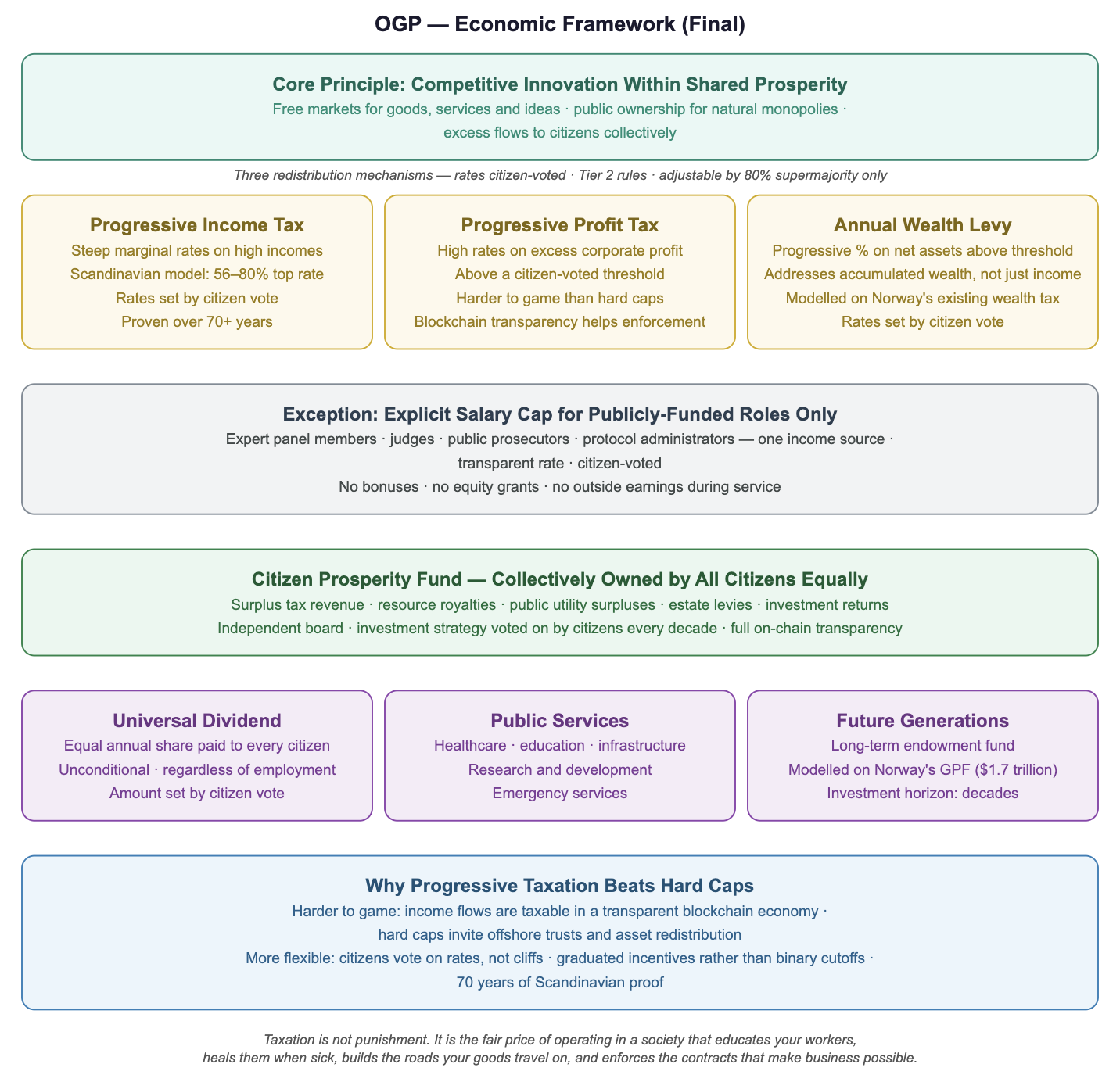
Taxation is not punishment. It is the fair price of operating in a society that educates your workforce, keeps them healthy, builds the roads your goods travel on, and enforces the contracts that make your business possible. It is a social contract, and in OGP, citizens vote on the terms.
The court structure
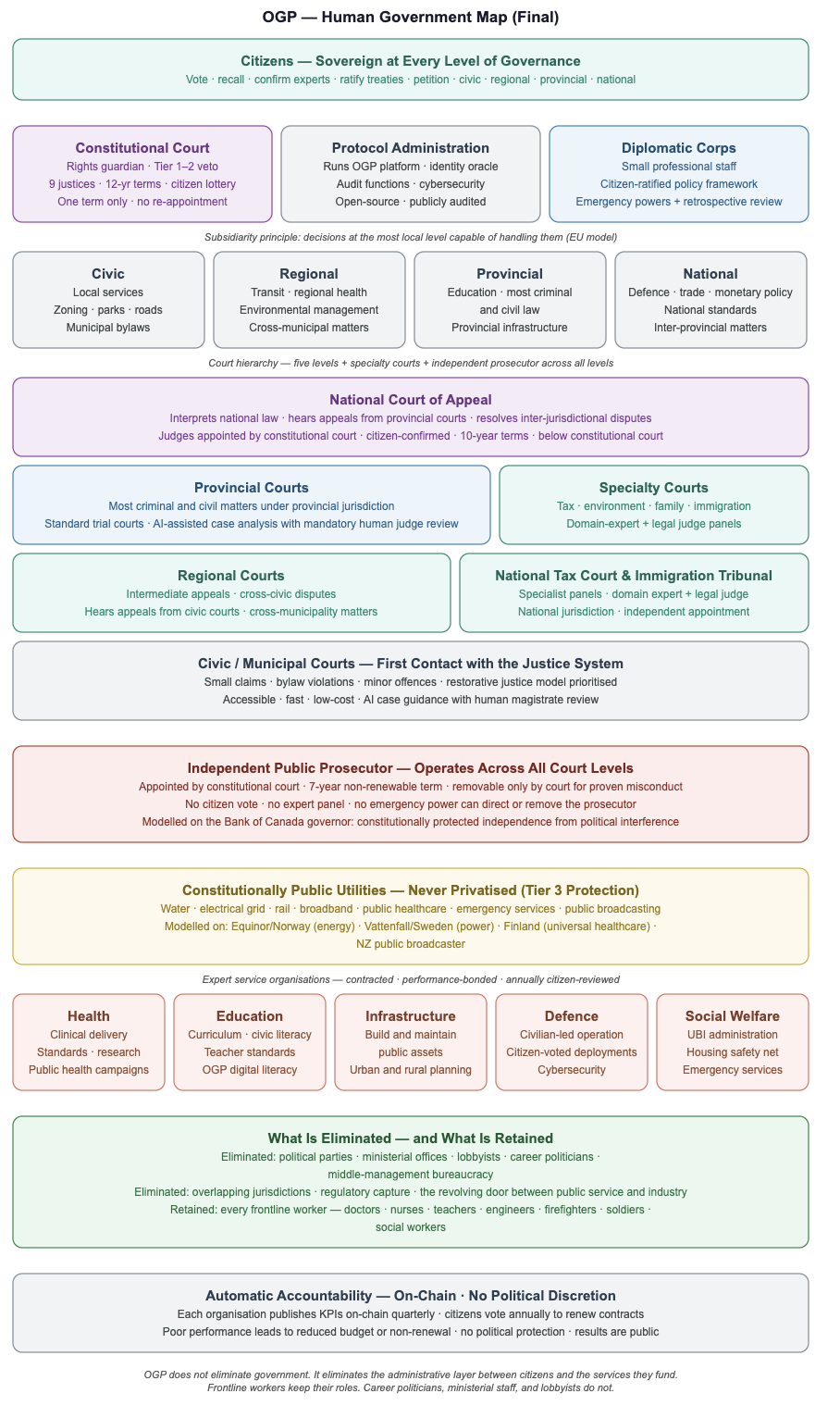
Above all, governance without an independent justice system isn’t governance; it is administration with impunity. OGP’s court structure has five levels:
- Civic courts: small claims, bylaw violations, minor offences. Accessible, fast, low-cost, with restorative approaches prioritised.
- Regional courts: intermediate appeals and cross-municipality disputes.
- Provincial courts: most criminal and civil matters. AI-assisted case analysis with mandatory human judge review.
- National court of appeal: national law interpretation, inter-jurisdictional disputes, appeals from provincial courts.
- Constitutional court: nine justices, twelve-year staggered terms, selected by citizen lottery from accredited legal scholars. One term only. The court’s job is to protect rights, not make laws. It has a veto over any legislation that would breach Tier 1 or Tier 2 rights, but no power to create policy.
Alongside these: specialty courts at the appropriate tier for tax, family, environment, and immigration matters. These combine domain experts with legal judges, because justice in complex technical areas requires both kinds of knowledge.
The independent public prosecutor operates across all five levels with constitutional protection from removal. The model is the Bank of Canada’s governor: appointed by the constitutional court, serving a seven-year non-renewable term, removable only by the court for proven misconduct. No citizen vote, no expert panel, and no emergency declaration can direct or remove the prosecutor. This is how you stop the criminal law from becoming a political weapon.
Expert governance: solving the technocracy trap
Removing career politicians and replacing them with experts is a common reform proposal. It fails consistently for the same reason: it replaces one form of concentrated power with another. The experts become the new political class, with the same incentive structures and the same accountability gaps, minus even the nominal democratic check of an election.
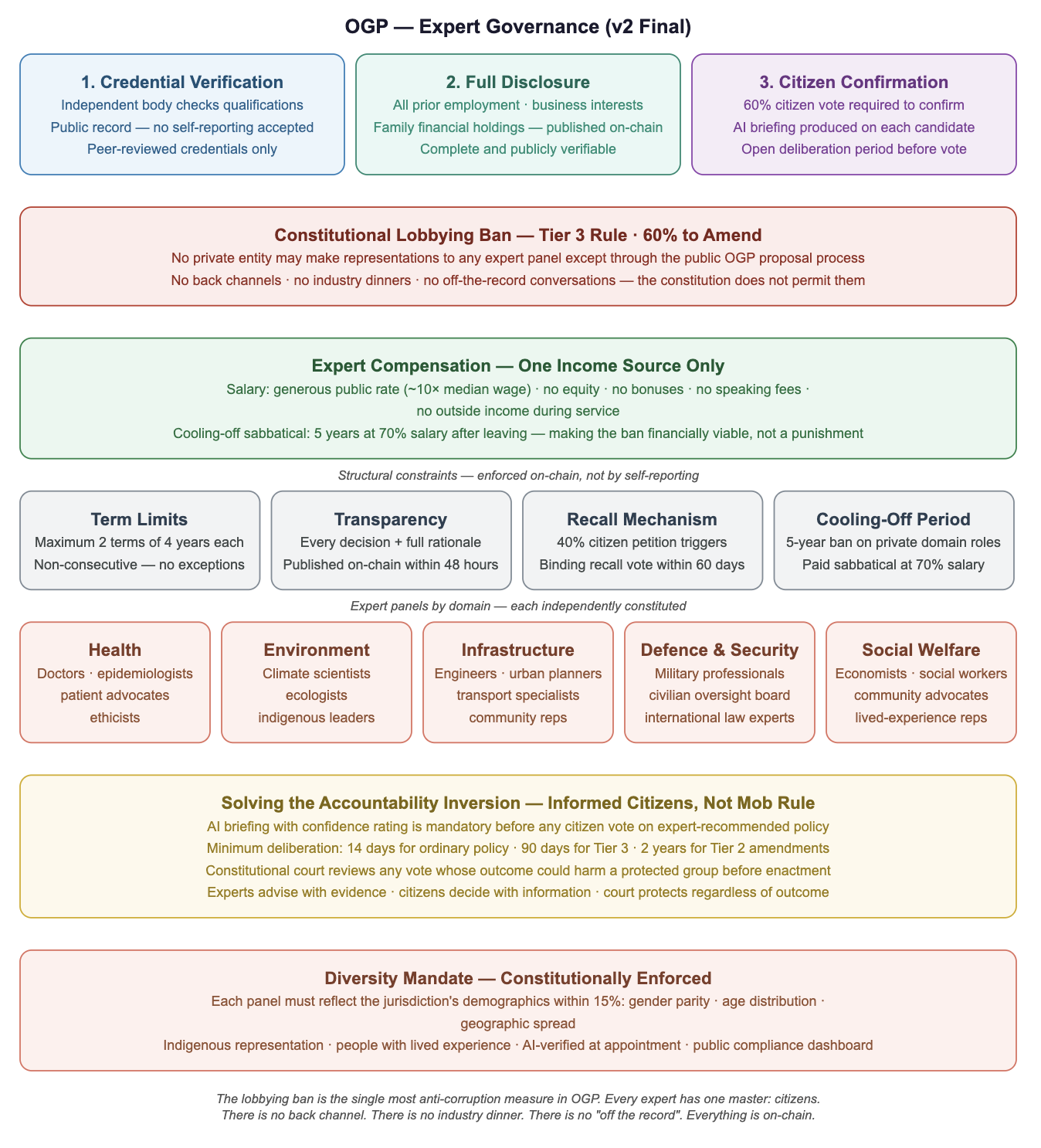
OGP solves this structurally, through five mechanisms:
- A constitutional lobbying ban. No private entity may make representations to any expert panel except through the public OGP proposal process. There is no back channel because the constitution does not permit one.
- One income source. Generous public salary, no bonuses, no equity, no speaking fees, no outside income during service.
- A paid five-year cooling-off period after leaving public service. Experts cannot take private roles in their domain for five years, and are paid 70% of their salary during that period, making the constraint financially viable rather than punitive.
- Recall by citizen petition. A 40% citizen petition triggers a binding recall vote within sixty days. No expert is insulated from accountability.
- A diversity mandate enforced constitutionally. Each panel must reflect the demographic composition of its jurisdiction to within 15%, covering gender, age, geography, and indigenous representation. Verified at appointment and tracked on a public dashboard.
Expert panels advise and execute. Citizens decide. The constitutional court protects. The independent prosecutor enforces. No single layer has unchecked power, and every layer is independently auditable.
What stops citizens from voting against their own interests?
On the accountability concern (what stops citizens from voting for emotionally appealing but harmful policies): three safeguards work together. The mandatory AI briefing with a confidence rating gives every citizen access to substantive analysis before they vote. The deliberation windows create mandatory time for reflection before any significant decision takes effect. The constitutional court reviews any outcome that could harm a protected group before it is enacted. Citizens vote informed. The court protects those who might be harmed by the outcome regardless of vote count. Experts execute what citizens decide, within constitutional limits.
The technical proof of concept
Here is what separates OGP from every other governance reform proposal I know of. This is not a white paper. The architecture described above has a working technical implementation. All of it is open-source and available for anyone to read, audit, run, or improve.
Layer 1: Verified identity (XRP Ledger)
Every citizen gets a soulbound NFT on the XRP Ledger. Soulbound means non-transferable at the protocol level: not just prohibited, but architecturally impossible. Transferring or selling it would require breaking the underlying ledger itself.
The identity tree is designed to scale from a single village to a planetary civilisation without any changes to the structure. Think of it as a massive tree where each leaf represents one person’s identity slot. The tree has 64 layers of branches. That means it can hold two to the power of 64 identity slots, which works out to 18.4 quintillion positions, more than two billion times the current population of Earth. A small community pilot might use a handful of those leaves. All of current humanity would use around eight billion. A future civilisation of trillions would still have room to spare. A separate top-level structure allows new jurisdictions (or eventually, new planets) to be added at any time without redesigning anything.
Layer 2: Quadratic voting (Polygon)
Smart contracts on Polygon enforce the voting rules directly. Each citizen gets 100 voice credits per proposal. The cost of votes is quadratic: one vote costs one credit, three votes cost nine credits, ten votes cost all one hundred. This makes it economically irrational for any actor, no matter how wealthy, to dominate any vote. The more you concentrate your influence on one issue, the faster you burn through your budget.
All ballots are private, verified by zero-knowledge cryptographic proofs. Here is the simplest way to understand what that means: imagine proving to a bouncer that you’re over 21 without showing your ID and revealing your name, address, and exact birthdate. A zero-knowledge proof lets you do exactly that: prove you meet the criteria without revealing any of the underlying information. When you cast a ballot in OGP, you generate a mathematical proof that says “I am a registered citizen, I have not voted on this proposal before, and my vote follows the rules.” The system verifies that proof without ever learning who you are or what you voted.
Layer 3: AI advisory pipeline
Every proposal triggers a structured analysis pipeline. An open-source language model produces a briefing with plain-language summary, risk scoring, predicted outcomes, historical precedents, and a mandatory analysis of how the proposal affects minority and vulnerable groups. A confidence rating tells citizens how certain the AI is. A citizen oversight panel reviews every briefing before it is published. The briefing is stored in a permanent, distributed system and its content is cryptographically anchored on-chain, so there is an immutable record of exactly what analysis citizens saw before they voted. The AI cannot trigger a vote. It cannot bypass the oversight panel. It informs.
Layer 4: Identity oracle (XRP Ledger to Polygon bridge)
The identity layer lives on the XRP Ledger. The voting layer lives on Polygon. A continuous oracle service watches the XRP Ledger for civic identity events, maintains a local database, builds the verification structures needed by both the Polygon contracts and the privacy proof system, submits them at each governance cycle, and serves proof packages to citizens through a simple API. A citizen calls one endpoint and gets back everything they need to claim their voice credits and cast a private, verified ballot.
The full source code is at https://github.com/Psycho-Drifter/ogp. Four directories: civic-id, civic-qv, civic-ai, civic-oracle. Every design decision has documentation explaining the reasoning. The code is intended to be read, audited, forked, and improved.
How we get from here to there
Crucially, OGP does not replace governments by force. It makes them redundant by being better. The transition follows the same path that transformed Estonia from a post-Soviet bureaucracy into the world’s most advanced digital governance system: deliberate, incremental, provably better steps.
Estonia started in the late 1990s with digital tax filing. Then digital voting. Then digital health records, then e-residency. Today 99% of Estonian government services are available online, the country runs on distributed blockchain-backed infrastructure, and the model has been studied by over fifty countries. They did not replace their government overnight. They made it progressively more digital, more transparent, and more accountable until the old model became the exception.
OGP follows the same trajectory across five phases:
- Phase 1 (years 1 to 3): Pilots in willing municipalities, indigenous nations, and cooperatives. Advisory only, no legal authority, pure proof of value.
- Phase 2 (years 3 to 6): Provincial adoption of budget referendums with binding results. First constitutional amendments recognise digital identity and direct voting.
- Phase 3 (years 5 to 10): Elected representatives formally defer non-emergency decisions to the platform. Parliament transitions from legislating to ratifying citizen votes.
- Phase 4 (years 8 to 15): A constitutional convention rewrites the framework for the OGP era. Ministries are replaced by funded expert service organisations.
- Phase 5 (year 15 onwards): Citizens vote directly on all policy. AI briefs every vote. A small constitutional court protects rights that no vote can override. Expert panels execute decisions transparently.
The platform never confronts existing government. It demonstrates that it is better, until the old model cannot compete.
What OGP hasn’t fully solved
I want to be clear about three things that remain genuinely open:
Voter coercion. Cryptographic proofs prevent anyone from proving after the fact how a specific person voted, which removes the market for vote-buying. They cannot prevent a family member or authoritarian actor from watching someone vote in person. This is a real-world problem every voting system shares, including postal ballots. The best available protection is cryptographic; perfect protection is not available.
Digital access equity. OGP treats digital access as a Tier 1 right and mandates paper-based alternatives. But the transition period before universal access is achieved requires careful management to avoid excluding populations without connectivity. The pilot phase has to prioritise this.
Cryptographic vulnerabilities. The mathematical foundations are sound and peer-reviewed. But complex cryptographic systems have had implementation vulnerabilities discovered years after deployment. The open-source mandate, citizen audit panels, and mandatory independent security reviews are the mitigations. Certainty isn’t available. Transparency is.
An invitation
This is a systems thinking proof of concept. The question I’m putting to you is not whether you agree with every design decision. Many of them will need revision, and the best revisions will come from people with expertise and lived experience that I don’t have.
The question is: does the architecture make sense? Does solving the structural problems of representative democracy, the capture, the corruption, the insulation from accountability, require this kind of foundational redesign? Or is there a path to equivalent outcomes through incremental reform?
Why incremental reform isn’t enough
Honestly, I don’t think incrementalism has the track record to answer that confidently. Attempts at meaningful governance reform go back centuries. The concentration of political and economic power keeps increasing. At some point, the question of whether to try a fundamentally different architecture becomes hard to avoid.
The comment section is the first test of open governance. Every objection, every gap, every “but what about” is data. Please bring them.
Constitutional lawyers who see a flaw in the tier structure: I want to hear it. Cryptographers with concerns about the zero-knowledge implementation: you can review the code directly. For indigenous leaders who see ways the system could replicate existing power imbalances under new branding, that is exactly the kind of feedback the diversity mandate exists to surface. And if you are a nurse, a teacher, a firefighter…
The infrastructure for honest government is being designed in public. That is how it should be.
Technical implementation (open-source): https://github.com/Psycho-Drifter/ogp
Part 1 of this series: Corruption-Resistant Government: Revolutionizing Democracy
Sources: UN Secretary-General on global corruption costs citing World Economic Forum and World Bank data (2018). Norway Government Pension Fund Global: nbim.no. Finland basic income experiment 2017 to 2018: Kela / Social Insurance Institution of Finland. Denmark and Sweden tax rates: OECD Taxing Wages 2025 and Tax Foundation. Estonia e-governance: e-estonia.com. XRPL XLS-20 NFT standard: xrpl.org. Circom ZK circuit documentation: docs.circom.io.
#OpenGovernanceProtocol #OGP #Democracy #DirectDemocracy #BlockchainGovernance #SystemsThinking #GovTech #DigitalGovernance #ConstitutionalDesign #FutureOfDemocracy